



 Masha Ibeschitz, Founder and Chairperson
However, the biggest challenge is that everything is moving enormously fast: market conditions, business requirements, people’s expectations towards organizations in general, and learning and development in particular. At the same time, employees demand efficient support and HR and development initiatives need to prove their validity with precise impact.
With more than two decades of experience in leadership development around the globe, Think Beyond Group helps in human-centered leadership development for sustainable business success.
Below is the essence of a conversation that Manage HR Magazine had with Masha Ibeschitz, the Founder and Chairperson of Think Beyond Group.
Dynamic & Flexible People Development
The biggest challenge when establishing an environment for successful leadership development is to stay flexible enough to respond to exponential change while also having a strong and reliable infrastructure. Both are necessary to stay competitive in the market while attracting and keeping the right people.
To create immediate and very precise benefits for participating employees comes with a multitude of requirements for people development and those involved: Operate in close connection with business and have all relevant stakeholders on board, creating immediate and very precise benefits for participating employees. And last but not least: Success has to be trackable to be able to testify to the effectiveness and value of a program at hand.
In the course of 25 years of leadership development around the globe and collaboration with top experts from multiple countries, we condensed vast experience and scientific research results into a highly useful framework: The Dynamic Loop Method.
The Dynamic Loop Method: Development processes for overall Workforce Productivity and Business Growth
The Dynamic Loop Method is a functional 5-phase method for people development that contributes to short-term business goals while also supporting long-term people development strategies. Flexibility, targeted and measurable impact, as well as constant adaption, are anchored in its DNA to tackle the challenges mentioned above. The 5 phases make sure that any key element of successful people development is considered. These elements are based on scientific research as well as on real-life experience. The specialty, however, is the loop approach: In intervals of three months, all relevant stakeholders come together for a quick exchange to evaluate: What went well? What do we need to change? How have conditions and goals changed? This tiny element is a real game changer. What makes us somehow special is our way of “breathing with our customers”. We work with specially trained and experienced people – called Loop Managers – who really dive deep into the company DNA and continuously find ways to grow based on prior experience. We put ourselves in the shoes of your board and HR department and treat your success just as we approach our own.
The Five Phases of Dynamic Loop Method
The Dynamic Loop Method begins with existing development initiatives in companies. There is no need to stop all initiatives and start from scratch. It involves a dynamic framework for timely effectiveness and transfer efficiency. Through regular assessment, evaluation, and adaptation, the method ensures that the effectiveness of human resources and organizational development increases. The entire organization is always supported in achieving its most important business goals.
Goal Phase: Business sponsors are on board from the very beginning. Based on current business needs, they set short-, medium- and long-term goals. Business managers in the company, HR as well as organizational development, and external partners then jointly analyze and define the need for new success-critical behavior on the part of the employees. What (new) behavior should be demonstrated in the future to achieve current goals? To make it more tangible, you can work with a persona question. For example, the persona of a participant in a development measure is filmed before and after going through the development measure—what new behavior becomes apparent?
Design Phase: In this second phase, internal HR and organizational development and the external partners design processes that fit the goals defined. In this context, they answer the question: How should employees be prepared in order to be able to demonstrate the expected behavioral change in everyday life? In the process, they either set up new development initiatives or further develop existing ones. Here, content, transfer measures, didactics, and formats are defined. (The portfolio ranges from self-directed learning to training, mentoring/coaching, structural/organizational adjustments, etc.) A foundation has been established.
The biggest challenge when establishing an environment for successful leadership development is to stay flexible enough to respond to exponential change while also having a strong and reliable infrastructure . Both are necessary to stay competitive on the market while attracting and keeping the right people.
Network Phase: Here, we focus on sustainable future implementation (transfer effectiveness), which can only succeed in conjunction with the relevant stakeholders and those affected. In this phase, HR and organizational development define all stakeholders and involve them. How will different units and individuals in the company support each other in learning? For this purpose, arrangements are being made. We create a strong and flexible co-learning, communication, and implementation network. The more tightly woven the network, the greater the likelihood of success.
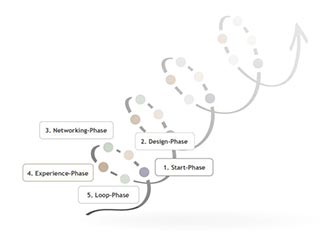
Experience Phase: In this phase, we deliver. Employees experience the respective development initiative in a precisely coordinated mix of digital and analog formats. They experience meaning, witness immediate results, and know that their time investment is worthwhile. Short-term support is complemented by long-term perspectives that are repeatedly presented to them.
Loop Phase: At three-month intervals, we review and evaluate everything that has happened up to that point. Are the goals still visible? Is the relevance, quality, and implementation success appropriate? Depending on the results of this evaluation, the initiatives are re-adjusted. Sometimes more, sometimes less. Last but not least, the sponsors are asked to provide feedback and refine the goals that have been set. It is possible that profound organizational changes will take effect during the process in a rapidly changing world, especially if your development measures accompany entire transformation processes. The loop phase helps to include this dimension repeatedly in order to adapt the process. The short-term iteration from a business, PE, and OE perspective is particularly important here. The loop phase forms the transition to another phase one.
The Right Connections to Unlock the Best Potential of People Development
Working with development agents within the organization, we learned to ask questions that usually are not asked to add value and trigger thinking beyond different units. This involves your current leadership program, different hierarchies, the board’s decision about the current impact of the program on business success, and the plan to illustrate the contribution of the program to all stakeholders. Behind all these questions is the idea of connectivity. A lot of connections need to be lived in a vital way for people development to really flourish: business and HR, training design and on-the-job application, participants and their line managers —just to name a few for 25 years now. And within these 25 years and thanks to very courageous, dedicated customers, we tried and tested everything out there in terms of development design and transfer effectiveness, enriched it with what we learned is necessary for success, and condensed it to a simple process: The Dynamic Loop Method.
The Leading Factors of Think Beyond Group
What unites all people involved at Think Beyond is a fascination for humans and the most creative ways to support these humans on their growth paths: As individual leaders as well as company heads. We speak more than 20 languages and have already realized workshops, keynotes, and huge programs on each continent. Business is where we come from, and human-centered leadership development is our favorite way to support it.

