



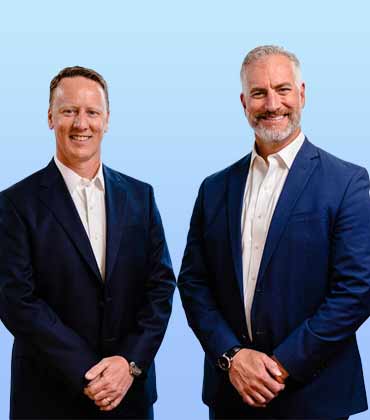
 Chad Carr, Managing Partner, Matt Herzberg, Managing Partner
That’s where Principled Transformation comes in. Founded by former Fortune 500 executives Matt Herzberg and Chad Carr, the company specializes in ‘Culture Transformation at the Speed of Thought™’. It helps organizations embed culture change into the way people already work, through approaches that are simple, scalable, and proven to work across industries and geographies.
“Our clients are already busy. We don’t give them more to do—we help them do what they’re already doing, better,” says Herzberg, managing partner.
The company emphasizes that the challenges might be specific to different industry verticals, but the underlying issues are often the same: misalignment, fractured collaboration, slow innovation, and unclear accountability. These problems remain difficult to solve because many approaches treat culture as a standalone initiative, separate from day-to-day business priorities. Consultants often deliver dense frameworks and abstract models that rarely shift daily behavior. Principled Transformation’s model addresses these pain points in ways that are both repeatable and adaptable for organizations of all sizes — be it 500 or 500,000 employees.
Focusing instead on business outcomes like revenue growth, integration speed, and margin improvement, Principled Transformation drives culture change through impacting how leaders lead. One of its core messages, featured across its materials, is direct: “Drive culture transformation without adding to your calendar.”
“Every meeting, every decision, every one-on-one is a culture moment. You don’t need separate culture committees and task forces to build culture—you need leaders to show up differently,” says Carr, managing partner.
That philosophy shapes every step of its process, beginning with aligning executive teams around three essentials of purpose, values, and business priorities. This isn’t a branding exercise—it’s about surfacing assumptions, resolving contradictions, and creating shared clarity.
-
Our clients are already busy. We don’t give them more to do—we help them do what they’re already doing, better
The next step is capability transfer. Rather than embedding long-term consultants, Principled Transformation trains internal facilitators and leaders to scale the work, leading the first wave before stepping back as client teams take over.
Diagnostics play a foundational role, using the company’s validated culture assessment tools to uncover informal behaviors and unspoken norms that shape how things get done. With that insight, leaders shift culture through what they consistently model, reward, and tolerate in organizations. Digital tools accelerate this rollout and help organizations rapidly scale. Microlearning and e-learning modules enable organizations to distribute content enterprise-wide within weeks, not years. Combined with live facilitation, these tools extend reach without burdening leaders with extra meetings.
Culture change begins in everyday actions. As Carr often puts it in client sessions, a leader’s calendar isn’t an obstacle—it’s the vehicle.
This approach has delivered results across sectors. For instance, a global consumer company used Principled Transformation to build stronger shared services and unify its brand. After realigning leadership and driving accountability, it streamlined acquisitions and tripled its stock price. Another client, a high-performing oil and gas firm, had tried a different consultancy the year before—with little to show for it—but after partnering with Principled Transformation, saw immediate improvements in collaboration and execution. These aren’t exceptions—the company’s methods have succeeded across organizations of all sizes, delivering measurable impact without extended timelines or disruption.
Herzberg and Carr have held the same leadership roles their clients now occupy. They understand the time pressure, political tradeoffs, and difficulty of creating real change while still running the business. That’s what sets Principled Transformation apart—it’s not just the method, it’s the people behind it. They built the company to transfer capability, ensuring culture change is owned internally and sustained over time.
For today’s leaders, time is the scarcest resource, and that’s why Principled Transformation builds culture into the calendar, not on top of it.

