


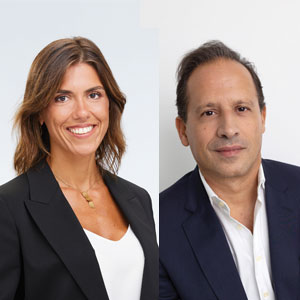
 Maria Conceição Serra, Senior Partner Founder, Fernando Pedro Novais, Senior Partner Founder
In an interview with Manage HR, Fernando Pinto Novais and Maria Conceição Serra, senior partner founders of P4S, shed light on how neuroscience and their psychometric tools promote healthy behaviour in training participants and speak on the first-hand growth they’ve seen in their clients.
Building Self-Awareness with a Unique Approach Fernando:
My colleagues Marina Pinheiro, Maria Conceição Serra, and I founded P4S. We come from managerial backgrounds in different industries, including startups, larger corporations, and clinical practices. P4S combines all the knowledge we’ve amassed from our respective careers into an integrative solution that helps people become better leaders. Our approach encourages them to introspect and enhance their self-awareness, emotional intelligence, and self-management skills. This has a positive impact on how they treat the people around them.
Our team’s diverse backgrounds plays into the uniqueness factor of P4S, enabling us to curate out-of-the-box solutions for our clients. The unity of an organisation depends on its people and the way they behave, which is why neuroscience is a core part of the way P4S designs its programs. We believe discarding neuroscience principles is akin to not using the Internet in this day and age. Our unique way of working draws in our clientele, which comprises of multinational organizations, business schools, and universities.
Maria: Similarly, our value proposition’s basis is in our distinctive approach to problems. Our understanding of a client’s challenges, combined with our varied backgrounds and the science-based tools we have in our arsenal helps us achieve that standard of success we consistently see in our work.
Understanding the Client’s Reality Maria:
P4S’ customers often face “The Peter Principle,” the concept that employees are promoted based on their successes from previous jobs until they reach a point where they’re no longer competent due to a lack of required skills. P4S tackles this problem, by addressing the lack of soft skills in rising and potential leaders. Without the ability to manage their emotions, leaders cannot motivate their teams, communicate with stakeholders, or resolve conflicts among their colleagues. An organisation without a competent leader will have neither productive nor motivated employees.
Fernando:P4S specifically deals with the field of leadership development. We recognise our clients’ potential to become great leaders, and our programs give them the nudge they need to grasp it. We avoid viewing our clients through a corporate lens, viewing them as people with families, their own strengths, and who carry trauma. These factors impact their performance, which is why we take an integrative approach.
Employing Psychometric Tools to Get to the Root Issue Fernando:
Our process typically starts with a diagnosis based on the client’s problems. We collect the necessary data using methods that help us understand their situation. We measure its effectiveness after designing and executing a suitable action plan that utilizes the many psychometric tools at our disposal. For personality development, P4S’ most-requested tool is the MBTI Personal Development program to aid the understanding and development of teams. Each member of a team needs to understand their peers are different. Everyone has a different approach to a problem, but this can work to their advantage, so we emphasise the importance of valuing the diversity of mindsets in a team.
P4S also employs two personality assessments—the Pearman Personality Integrator and the Everything DiSC—that give users better insights into themselves. We use them to encourage positive workplace interactions and improve the organisation’s culture. For emotional intelligence, P4S uses a specially designed self-evaluation tool, the EQ-I 2.0, to promote self-awareness in our program participants. It scores users in different aspects of their personality and helps us identify what the participant needs to focus on for self-improvement. We also have the EQ360, similar to the EQ-I in that it identifies the gaps in a person’s behaviour. However, this relies on the perceptions of the people around the person and their self-perception.
Our organization combines all of the knowledge we’ve amassed from our respective careers into an integrative solution that helps people become better leaders
Maria:
These tools supplement our programs, many of which are rooted in emotional intelligence, an integral concept to developing teams and leadership skills. Skills like problem-solving, flexibility, interpersonal relationship, and empathy are covered. In all our programs, participants receive practical exercises to apply the session’s content to their day-to-day lives. Ultimately, we help change habits and encourage better work performance and personal well-being.
Creating a Long-Lasting Impact on the Way Leaders Interact
Fernando:All our clients grew in their respective companies after experiencing our programs. Presenting success stories is difficult due to the nature of our work requiring us to operate under confidentiality, but our organisation’s continuous growth and prestigious clientele speak for our effectiveness. P4S initially started operating in Portugal, but through word-of-mouth recommendations, we’ve expanded to Spain and England without strategizing for it.
Maria: We also use the feedback we receive from customers as a barometer for our success. I’ve personally received communications from clients who worked with us years ago, informing us how P4S’ program positively influenced how they interact with people. The intimate stories I hear help me understand how much our work has assisted others.
Fernando: We see the positive results our clients share with us, and it motivates us. The team at P4S enjoys what we do every day; we don’t feel like we’re working.

