




 Rob L. Kimmons, President
The Houston-based firm works with HR professionals on matters that sit at the intersection of people, information and corporate security. Pre-employment investigations are only part of the practice, alongside workplace investigations involving employee threats, terminations and harassment. Additionally, the company also conducts surveillance, computer and cell phone forensics and technical countermeasures.
“HR departments are realizing how private investigators can be a part of their team and how they can be helpful in a number of areas,” says Rob L. Kimmons, President.
The variety of those cases reflects the reality of HR work. Employee concerns rarely arrive in neat categories. A question raised during hiring may lead to another concern later, while a workplace incident may require a closer look at a person’s background, conduct or use of technology.
Kimmons Investigative Services provides an investigative resource that can remain involved as an issue develops. Rather than treating each capability as a separate service, it can bring together the investigative skills needed as a corporate or HR matter becomes more complex.
Turning Background Screening Into Due Diligence
Many companies conduct screening through databases, reference checks or internet searches. Kimmons Investigative Services takes a broader approach when a client needs deeper due diligence, tracing where an applicant has lived over the previous 15 to 20 years, examining records across multiple jurisdictions and pursuing leads that emerge during the search.
 Depending on the position, the review may extend into criminal and civil records, driving history, financial records, references, education and social media. The scope changes according to the job, since a truck driver and a corporate executive do not present the same investigative requirements.
“We try to tailor a pre-employment to a client’s needs and the job description,” Kimmons says.
The distinction becomes important when a search produces an incomplete answer. A database may show a criminal record without providing enough context to understand it, while a discrepancy may require verification. Investigators can contact a courthouse, retrieve the underlying record or use a local investigator to pursue information in another jurisdiction.
The goal is not simply to collect records but to understand what they reveal and determine whether additional questions need to be answered before an employer makes a hiring decision.
Kimmons’ instinct to keep digging comes from a career that began in firefighting before moving into law enforcement, private investigation and corporate security. A former Houston police officer and retired captain with the Harris County Sheriff’s Department, he holds Certified Protection Professional, Certified Fraud Examiner and Master Peace Officer credentials.
The Problem Does Not End at Hiring
The company’s broader role becomes clearer when an employee is already inside the organization. A termination may require an investigator to be present when an employee is considered potentially hostile. Harassment allegations can call for experienced interviewers, while a workplace theft inquiry may eventually involve company computers and/or phones.
-
HR departments are realizing how private investigators can be a part of their team and how they can be helpful in a number of areas.
Interviewing is a particularly important part of sensitive workplace investigations. Experienced investigators must gather useful information without making people unnecessarily defensive, especially when allegations involve harassment, misconduct or personal conflict. Kimmons notes that the investigators assigned to such matters are typically former law enforcement and may have conducted hundreds of interviews.
The firm also keeps clients closely involved as investigations develop. It gathers information, explains available options and updates the client as circumstances change. Major investigative decisions are discussed with the client rather than being taken unilaterally, including whether law enforcement should become involved.
For matters involving legal sensitivities, the company can also run issues by its in-house counsel while coordinating investigative decisions with the client. This resource supports careful handling of complex assignments for Kimmons employees without positioning the firm as a substitute for the client’s legal counsel.
Employee threats can introduce another level of complexity. In one case, investigators placed an employee under surveillance after he threatened executives and made it known to them that he knew where they lived. Rather than stationing security personnel at six executive homes, Kimmons followed the individual for about two weeks.
The situation eventually escalated to threats against the firm, requiring law enforcement involvement. This case illustrates how an HR matter can quickly move from an internal process to a security concern requiring specialized investigative resources.
When a Workplace Case Becomes a Security Investigation
A separate investigation involving a company handling confidential defense-related work demonstrates how several capabilities can converge in a single case. An employee was connected to theft and was allegedly providing information to a competitor while under a non-compete agreement. The situation became more complicated when listening devices were discovered in company offices.
Kimmons Investigative Services responded with countermeasures, surveillance and digital forensics. Company computers and cell phones were examined as investigators pursued evidence connected to the case.
What began as a workplace matter ultimately required capabilities that are not typically associated with a conventional HR investigation. Investigators had to determine what had occurred, identified potential sources of information and examined whether technology had been used to compromise the organization.
This case demonstrates the practical value of a full-service investigative model. A single matter can require people with different specialties, from professional interrogators conducting interviews and surveillance to specialists examining devices or identifying technical threats.
Where Corporate Security Meets Technology
Traditional investigative work remains central to the company’s approach. People still drive interviews, surveillance and information gathering, but technology has changed the evidence investigators encounter and the methods required to examine it.
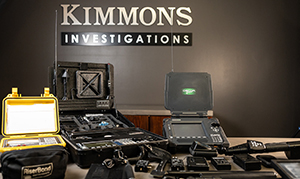
Technical countermeasure sweeps allow investigators to examine offices, executive homes and vehicles for listening devices, recorders or tracking equipment. The work requires specialized equipment and training, particularly as tracking technology becomes smaller and harder to detect.
Kimmons says investigators frequently encounter vehicle trackers, while some devices can be difficult to locate without appropriate equipment. His professional résumé includes advanced counterintelligence and counter-surveillance training, along with graduation from the REI Countermeasures Academy in Tennessee.
Digital evidence provides another investigative layer. A company laptop or cell phone can contain information that helps establish what happened during an employee theft investigation or a dispute involving confidential information. Kimmons has the capability to focus on computer and cell phone forensics.
Forensic analysis and countermeasures gives investigators additional ways to establish what occurred when interviews and database searches are no longer enough. The combination also allows the firm to respond when a workplace investigation develops into a broader corporate security matter.
Experience Built Through Relationships
Kimmons Investigative Services has six employees, supported by contractors and specialists who can be brought into assignments as needed. Several have worked with the company for decades, including one of Kimmons’ closest colleagues, who has been with him for more than 30 years.
 The network includes former law enforcement professionals and people with backgrounds in Texas state police, the Secret Service and corporate security. The company also maintains contacts with private investigators, information brokers, process servers and law enforcement agencies nationwide.
Those relationships have proved useful for law-firm clients handling investigative matters across multiple jurisdictions. Rather than locating a different investigator for every assignment, clients can draw on a network developed over decades.
The company operates from Houston, Austin and Fort Worth and says it has worked with HR professionals in major companies, cities and counties across more than 40 states. It also conducts broader corporate due diligence, including background research involving companies, individuals and transactions.
Trust and a Deeper Role Within HR
Corporate investigations often involve allegations concerning employees, confidential business information, executive security and/or potential litigation, making discretion fundamental to the relationship.
Confidentiality is central to the firm’s work, with client information not disclosed without authorization. Much of the business also comes through referrals, making trust an important part of how the company has built its client base. The company also points to the care built into its long-standing professional and licensing record. Its approach emphasizes careful investigative work, communication with clients and the use of experienced specialists when an assignment requires expertise outside the core team.
HR is becoming a more deliberate part of that growth. Kimmons says approximately 40 percent of clients are connected directly or indirectly to HR, prompting him to become more active in the HR community, including a speaking engagement at the 2026 Gulf Coast Symposium on HR issues in Houston.
 The connection reflects the range of situations HR professionals encounter. Investigative needs can arise when an employee enters the organization, during employment or when a departure requires additional care. A case can also move into surveillance, digital forensics and/or countermeasures when circumstances demand it.
Four decades in the field have given Kimmons a network built through relationships, experience and judgment. The result is a firm that brings together background research, workplace investigations, surveillance, digital forensics and technical countermeasures under one investigative practice.
That reach is also shaping the company’s next phase. With its Texas footprint expanding, the company plans to extend its geographic network so corporate and law-firm clients can bring more multijurisdictional assignments through one established investigative relationship.
For HR professionals, the value lies in having those capabilities available when a routine question deserves a deeper answer. The combination of investigative depth, specialized expertise and long-standing relationships has earned Kimmons Investigative Services recognition as Top Corporate Investigation And Security Solutions 2026.

