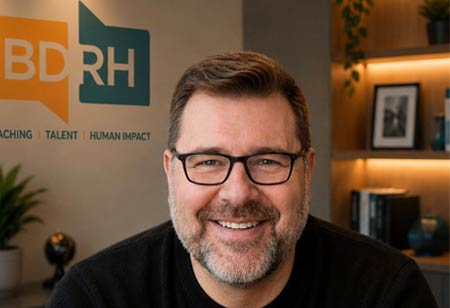
Robin began her career as an engineer in a manufacturing facility before transitioning into financial services as an operations analyst. For over two decades, she has combined her passion for design with the art of conversation, working with clients around the world in financial services, manufacturing, fashion, healthcare, technology, and the nonprofit sector. She loves helping others cultivate deeper connections through meaningful conversations, offering both profound insights and practical skills that empower clients to create greater impact and more joy in their work.
As technology evolves and the world grows increasingly complex, Robin firmly believes that human connection is the essential—and often overlooked—leadership skill needed for success.
Almost everywhere I go these days, clients of all shapes and sizes are talking about AI – what to do with it and what to do about it. Artificial intelligence is rapidly impacting us all. Decisions are faster, data and analysis are more readily available, and systems increasingly shape outcomes across every function, from hiring to performance management to client experience.
Yet beneath this acceleration, many leaders are confronting a deeper question:
What does leadership actually require now?
Technology is transforming how decisions are made, but leadership still happens in the moments between people.
And those moments live, almost entirely, in conversations.
The Leadership Gap No One Is Talking About
Most organizations today are not struggling with a lack of communication. If anything, they are saturated with emails, dashboards, collaboration tools, and AI-generated outputs.
What’s often missing are the conversations that matter most:
The ones that build trust in times of uncertainty
The ones that challenge assumptions and enable growth
The ones that require clarity, not avoidance
As speed increases, these conversations don’t disappear. They become easier to delay, soften, or unintentionally bypass.
That’s where leadership matters most.
Reclaiming “Love” as a Leadership Discipline
In many workplaces, the idea of leading with “love” can feel out of place. It may sound soft, vague, or too far removed from performance.
But this interpretation misses the rigor embedded in the concept.
Love, in leadership, is the commitment to truly see another person and to support their growth and development.
That commitment is not always comfortable. It requires:
Letting go of assumptions about what others should want
Having conversations that challenge, not just affirm
Prioritizing long-term growth over short-term ease
In this sense, love and accountability are not at odds. Love is part of what makes accountability meaningful and possible.
Where Leadership Happens: Presence and Listening
If leadership is expressed through conversation, then two capabilities become foundational: Presence is the ability to engage cognitively, emotionally, and physically. To notice what is happening both in yourself and in others with attention and awareness, rather than immediate judgment. This is what allows leaders to notice when something people are misaligned, when someone has stopped engaging in a meeting, or when something is being left unsaid.
Listening is the discipline of seeking to learn, rather than preparing to respond. It means being open to a perspective that may differ from your own and being willing to learn from it. Too often, leaders listen just long enough to translate what someone said into what they themselves would have meant.
But real listening asks a different question:
What does this actually mean to the person in front of me? What can I learn from them or about them in this moment?
Because in every conversation, people are signaling what matters to them. Often, it’s just not expressed directly; you have to listen for it. Years ago, we were getting ready to run a leadership development program for a group of financial services leaders. A member of their team reached out to us directly. When I got on the phone with him, he began to yell about what a waste this was, that this group of leaders would never listen, that he’d been there for 10 years and given so many ideas that were never put into practice. He went on for about 10 minutes, saying how this group would just never change, and the money could be used for other things. He was clearly angry. And superficially, the conversation sounded like it was about the waste of time and money. But inside of that complaint, I also heard despair; a feeling that he would never be able to make the difference he wanted to because leadership wasn’t listening. So I told him just that. At the end of the call, he said he had more hope than he’d ever had for the organization. This is what I mean by listening for what the other person cares about inside of any complaint or disagreement that they may present.
What AI Changes—and What It Doesn’t
AI is reshaping workflows and accelerating decision-making. It can analyze data, identify patterns, and generate recommendations at scale.
But it cannot (at least today):
Feel trust building (or crumbling) on a team
See the reaction on someone’s face in a meeting
Know that someone’s dad is really sick and they are stressed by having to care for him while providing for their family
-
The most powerful tool they have is not technology, but conversation.
Those remain human responsibilities.
In fact, as organizations rely more on systems, the quality of leadership becomes more visible. The gap between efficient decisions and meaningful understanding can widen quickly if leaders are not intentional.
The Choice Ahead
As AI continues to evolve, organizations will continue to adapt. But technology alone will not determine the experience people have at work.
Leaders will.
More specifically, it will be determined by the conversations leaders are willing—or unwilling—to have.
Because while AI may change what work looks like, it does not determine what it feels like.
That remains a uniquely human choice.
A Final Question
As you consider your own leadership, start with this simple question:
What conversations am I not having that would change the experience of the people I lead?
In an age defined by intelligence, the leaders who stand out will be those who choose to lead with love and who understand that the most powerful tool they have is not technology, but conversation.