
Manage HR Magazine: Specials Magazine
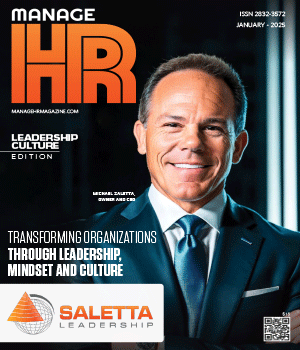
“Either you create the culture, or the culture will create you,”—Michael Saletta, visionary owner and CEO of Saletta Leadership. His powerful statement cuts to the core of every leader’s true challenge. A culture always takes shape within an organization. The question is, will it align with the leader’s vision and propel the organization forward, or will it develop haphazardly, driven by fragmented training and transient knowledge that fail to inspire change? Saletta’s insight speaks directly to this problem. He rejects superficial, short-term fixes to culture-building and underscores that true cultural transformation demands a sustained commitment to working with the entire workforce over the years to authentically evolve their culture. The transformation begins with a thorough, multi-level needs analysis across four areas—business, performance, learning and work environment. From this foundation, specific leadership behaviors are identified and cultivated, then systematically embedded into every layer of the organization, ensuring a culture that is aligned with the organization’s unique objectives and capable of driving long-term growth. Saletta has refined this process with his Performance Aligned Leadership Model (P.A.L.M.), a sophisticated, seven-layer framework that offers a strategic path to building high-performance teams and achieving seamless alignment at every level. From executive leadership to middle management, P.A.L.M. facilitates the deep-rooted alignment needed to permeate an entire organizational structure. The result is a culture that doesn’t just survive but thrives, fueling enduring success. Decoding P.A.L.M. Let’s compare a company’s leadership with the back of a hand, with fingers spread apart, each representing a vital part of your organization—executives, managers or departments. The gaps between the fingers symbolize the disconnection between crucial elements like communication, customer relationships and team morale. In this fragmented state, the very lifeblood of the organization, revenue, culture and innovation begins to slip away through the gaps. Now, flip your hand and draw the fingers together. You see a solid, unified palm and fingers. This is the core of P.A.L.M.—an organization where every member is aligned, focused on a shared vision and working harmoniously as one, minimizing the chances of anything falling through the gaps.
Leadership Development

Importance of Using the Right Technology in Virtual Corporate Learning and Leadership Development Programs
Danny Canary, Director of Organizational Development & Learning, Ulta Beauty
Executive Search

Navigating Challenges and Trends in Health Insurance Leadership
Alan Derow, Sr. Manager, Benefits, Irvine Company
Organizational Culture

Intentional Leadership: A Practice of Self-Reflection
Amy Schultz, MSHROD, MSW, Chief Learning Officer & Executive Director Organizational Effectiveness, DTE Energy
Leadership Development

Practicing Change Management Effectively
Steven Fretwell, Senior Vice President, Learning and Leadership, Bozzuto
Emotional Intelligence

Command To Compassion: The Shift To Human-Centered Leadership
Rico Maranto, Sr. Manager, Leadership Development, WM
Executive Search
Avoid the Dreaded Role Play: DIY Simulations in Leadership Development
Colleen Berish, Director of Learning and Development, FCCI Insurance Group
Human Capital Management

The Value of Human Resources Leadership in the Gym and Health Club Industry
Pamela Brown, Vice President, Head of People & Culture, Crunch Fitness

IN MY OPINION
Employment Law
Driving Innovation in the Changing Landscape of Leadership Development
Liz Volk, Chief Human Resources Officer, Longo
LAST WORD
Keynote Speaker
Employee Development with Improved Leadership Skills
Vanessa Moya, Director of Learning and Development, Nando's PERi-PERi North America
IN FOCUS

Harnessing AI for Effective Leadership and Organizational Growth
AI’s impact on leadership management is transformative and multifaceted.

Enhancing Team Performance with Leadership Training
Effective leadership is the cornerstone of a high performing team.
EDITORIAL
Tech-Enabled Leadership
Technology significantly transforms leadership culture, with one key trend being digital leadership. This approach involves using technology to facilitate organizational transformation, increase productivity, and improve the overall experiences of employees and consumers.
A prominent aspect of digital leadership is the use of AI-driven decision-making tools. These technologies help leaders anticipate future trends, streamline processes, and make data-informed decisions. AI can quickly analyze vast amounts of data, providing insights that would be difficult to achieve manually. This trend fosters an agile and innovative organizational culture by enabling leaders to make decisions more swiftly and accurately.
AI analytics reveal trends in the market and employee performance, helping leaders improve engagement and customer satisfaction while automating repetitive tasks. The US market for executive coaching and leadership development is sizable in size. With a CAGR of 9.24 percent, it is expected to reach USD 147.48 billion by 2029 from an estimated USD 94.80 billion in 2024. This expansion results from the growing need for leadership development courses that use cutting-edge technology to improve organizational efficacy and leadership abilities.
In this edition of Manage HR, we explore the recent developments in the sector and how companies harness cuttingedge technologies to offer top-notch solutions.
We feature insights from industry expert Steven Fretwell, Senior Vice President of Learning & Leadership at Bozzuto, who emphasizes the importance of AI in talent development, creating a supportive environment during change, and measuring organizational health through people, performance, and customer sentiment for effective change management.
We also have Danny Canary, Director of Organizational Development & Learning, Ulta Beauty, who discusses how virtual corporate learning and leadership development programs, using tools like breakout rooms, live polls, pop quizzes, and pre-surveys, enhance engagement, collaboration, and personalization, ensuring relevant and effective training aligned with business goals.
This edition also showcases Saletta Leadership, which specializes in transforming organizations by cultivating a strong culture through intentional leadership, mindset, and strategic alignment.
In this edition of Manage HR, we aim to help you find the right partner for your business requirements.
Let us know your thoughts!

Be first to read the latest tech news, Industry Leader's Insights, and CIO interviews of medium and large enterprises exclusively from Manage HR Magazine
