




 Christopher Boucher, Founding Attorney
With the rapid integration of AI comes complex challenges, including ethical dilemmas, data privacy issues and security risks. HR leaders need to ensure that AI is deployed responsibly, safeguarding employee interests while fostering innovation.

As these dynamics unfold and the legal framework for AI remains in flux, the demand for a strong legal partner in the journey has become paramount.
Boucher Law, PC, a leading labor and employment law firm in California, is fully equipped to help organizations navigate these uncharted waters with its pioneering AI law practice. Building on its legal acuity, it carved out the niche practice to help private companies, nonprofits and government entities maneuver all legal areas involving AI, not just limited to employment law. The comprehensive approach covers commercial transactions, tort liability, litigation, data protection and privacy, intellectual property, technology, ethical considerations, and AI implementation in the workplace.
“We have an integrated AI practice that covers all areas of law, ensuring comprehensive guidance through the complex AI-related legislation,” says Christopher Boucher, the firm’s Founding Attorney.

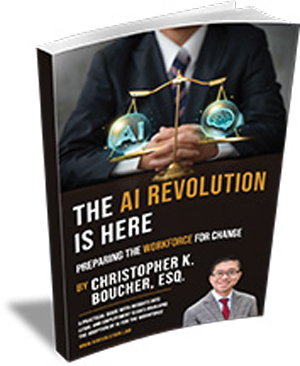
The intersection of AI and HR calls for a nuanced understanding of new legal and ethical landscapes and places a moral obligation on HR professionals to guide their workforce through transformative changes. Boucher’s new book—‘The AI Revolution is Here: Preparing the Workforce for Change’—is the comprehensive guide to demystifying the complexities of this digital phenomenon.
A Blueprint for AI Implementation in the Modern HR Repertoire
The book covers every topic on the impact of AI on HR practices. It begins with an introduction to AI, recent advancements and its adoption across U.S. industries, and then delves into AI’s applications in HR, including talent acquisition, benefits administration, performance management and talent development.
It highlights how AI is transforming these HR functions by improving workflow and efficiency, reducing the time required for tasks that once took days or weeks to mere minutes. It also sheds light on the impact AI can have on the workforce, including potential job displacement, discrimination, disability accommodation, bias, compliance with DEI principles, and safety concerns related to robots in the workplace.
Matters such as the implementation of AI in unionized settings are explored. While there are limited legal precedents addressing the emerging issues of AI in the workplace, the book offers analyses and analogies to existing cases to help employers navigate the issues ahead, while offering practical tips for effectively integrating AI within the workforce.
One of the most critical sections of the book discusses the HR professional’s role in maintaining ethical AI implementation in the workspace. It covers developing policies, addressing confidentiality and privacy concerns and conducting compliance audits. Practical implementation steps are provided, emphasizing the human factor and preparing the workforce for future change. The book reviews current federal and state guidance on AI and forthcoming legislation and executive orders.
It also addresses the most pressing question: Will AI take human jobs?
Boucher and his team argue that despite technological advancements, the human element remains indispensable. Much like the industrial revolution, which transformed work without rendering human labor obsolete, AI will reshape the nature of work but will not eliminate the need for human workers.
Boucher’s literary contribution promises to be a handbook for HR, covering a broad spectrum of concerns and ideas. Armed with this knowledge, HR leaders can effectively harness the power of AI while preserving the vital human element in their workspace.
Delivering Swift Legal Services through AI Integration
Boucher Law, PC truly embodies the principle of ‘walking the talk,’ incorporating AI into its own practices to provide practical guidance to clients. It has integrated AI into various legal areas, employing AI-assisted research, rapid document drafting and quick analysis of investigatory interviews and depositions.

“We are among the few firms with fully integrated AI-assisted legal research to enhance our practice,” says Boucher.
The integration of AI has significantly enhanced speed and efficiency. Traditionally, legal research involved hypothesizing what the law might be and then seeking out cases to support that hypothesis. AI has reversed the process. When given a specific legal question, it responds with comprehensive research and supporting information in a few seconds.
We have a Fully-Integrated Ai Practice that Covers All Areas Of Law, Ensuring Comprehensive Guidance Through the Complex AI-Related Legislation
In workplace investigations and depositions, it aids by providing near-instantaneous transcripts of interviews. It also delivers summaries from large volumes of data, greatly enhancing efficiency.

In a recent workplace investigation involving serious criminal liability, Boucher Law, PC conducted a crucial interview that lasted several hours. Traditionally, the client takes considerable time to review the recorded interview. Generative AI was able to deliver a transcript of every word spoken during the interview, along with a concise summary of the key points discussed, while everyone was still in the room.
The client was able to review the summary in just 10 minutes and discuss the findings immediately, eliminating the need for everyone to spend time listening to recordings and waiting to connect later.
Empowering Enterprises with Ethical AI Implementation
AI’s efficiency comes with a fair share of challenges for enterprises. A key one is recognizing the critical difference between AI mimicking human responses and genuine human reasoning, which is essential for understanding the associated legal liabilities.
Regulatory focus is also intensifying across international, federal, state and local levels, specifically targeting AI systems involved in making consequential decisions. As a result, transparency is another critical issue, particularly around when and if organizations should disclose their use of AI.
The impact of AI on the workforce is also a pressing challenge in industries with unionized labor. Addressing these concerns has become crucial for maintaining employee engagement, satisfaction and retention, even as many questions about AI’s impact on jobs remain unresolved.
Biases in coding, implementation and question framing can lead to skewed results, making it essential for clients to actively identify and mitigate them to ensure fair and accurate outcomes.
Boucher Law, PC’s AI group, led by Boucher and the firm’s Senior Counsel, Marc Zafferano, draw on decades of experience in studying and tracking AI to offer deep insights and practical advice to mitigate these risks. The best way to ease them is through human oversight at every stage of the process—before, during and after. It emphasizes this approach, particularly because AI decisions often lack explainability, and humans may struggle to understand or articulate the rationale behind the decisions. It highlights the critical need for human intervention to ensure that AI enhances efficiency without compromising accuracy and ethical standards.
“We are committed to being a key partner to Chief Human Resource Officers (CHRO), ensuring the ethical implementation of AI. We encourage CHROs to transparently communicate the impacts of AI to the workforce and to establish policies that promote fairness and equity throughout the organization,” says Zafferano.
A Future-Ready AI Strategy to Prepare Clients
In the coming year, the firm’s primary focus will be on further refining its AI practices. The firm takes a forward-looking approach to AI, helping clients anticipate and prepare for the future. It uses the concept of kaizen to guide its AI implementation strategies. This approach is not just about reacting to changes but about progressively preparing for the future of work.
It also places a strong emphasis on trust and reputation— key elements in any client relationship. The goal is to ensure that clients can confidently integrate AI into their operations without compromising their reputation or trustworthiness in the eyes of stakeholders.
Drawing from extensive experience working with multiple clients, Boucher Law, PC offers valuable insight into the practical aspects of AI implementation. This well-rounded experience makes it a trusted confidante in guiding clients through successful, ethical and impactful integration.

